Berlin Folk Festival: Interviews with Bedouine, Mia Wilson, Bernar Gomma, and Siba & Monkyman
- Michele
- 15 September 2026, Tuesday

At the end of August, our team attended the Berlin Folk Festival 2026, where we had the chance to speak with four artists performing live on stage: headliner Bedouine and Mia Wilson & Skyler, who traveled all the way from Los Angeles to Berlin to perform in our city; Berlin-based artist Bernar Gomma; and fellow Berlin residents Siba & Monkyman.
Read our recap and interviews to hear more from the artists and discover the highlights of this year’s festival.
Berlin Folk Festival 2026: A Brief Recap
Last August weekend, we went to the Berlin Folk Festival, and not only did we get the chance to be there (thanks again, Dan!), but we also got to talk to some of the artists performing at the festival.
The Berlin Folk Festival is a new festival that brings together artists, musicians, and visitors for a day centered around live music and creativity. “Berlin Folk Festival started as a colorful concept intertwining psych/folk music, '60s-inspired aesthetics, and live arts collaboration,” its organizer Dan explains. With the city being known for its club culture and a live music scene that often leans toward heavier, darker sounds, he felt there was something missing: a space for a community that gravitates toward psychedelic sounds and a more joyful atmosphere.
(Dan has also given some great advice on how to get booked for a festival as an independent artist. You can find the article here.)
The event took place at the venue Gretchen, a concert hall and club in Berlin that was built in 1854. What makes it stand out are its beautiful historic arched ceilings and visible columns, blended with a modern design suitable for a variety of events. Its architecture and its cozy, intimate space were a perfect fit for the atmosphere.
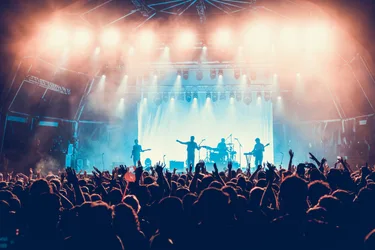
Our first impression of the festival could be summed up in three words: colorful, varied, and full of effort. With two separate stages and an outdoor area, there was a lot to explore, and each space offered a variety of activities to enjoy.
The two stages each had their own atmosphere, with a variety of artists performing throughout the festival and bringing different sounds and energies to the spaces. The stages provided different settings for the performances, with visual elements such as video projections adding to the experience and creating a more immersive atmosphere. Together, the two spaces offered a varied program and kept the festival feeling lively throughout the day.
Inside the main room, there was a drawing station as well as a vintage fashion and jewelry stand, featuring real coats, dresses, and many other unique pieces from the ’60s and ’70s. Fans could also buy merch at the merch stands and grab drinks from different spots around the room. Outside, visitors could grab some food, get creative at the painting station, or simply sit down and enjoy the nice weather we were lucky enough to have that day.
The crowd was full of kind, welcoming, and chatty people, with intriguing outfits and lots of excitement for the acts. Some were carrying vintage video cameras, capturing the atmosphere that Dan and his team had created, while others were simply taking it all in.

iMusician’s Artist Interviews at Berlin Folk Festival 2026
While the BFF team was busy with the final preparations before opening the doors to its visitors, we got the chance to chat with some of the artists performing at the festival: headliner Bedouine and Mia Wilson, who both traveled all the way from Los Angeles to Berlin to perform in our city, Berlin-based musician and artist Bernar Gomma, and fellow Berlin residents Siba & Monkyman.
Interview with Bedouine
The first artist we spoke to was headliner Bedouine, who came from Los Angeles to Berlin to perform at the festival. Known for her intimate storytelling and nostalgic sound, the US-based singer-songwriter has developed a distinctive sound of her own over the years. To get a better understanding of her music, we first asked her to introduce herself to our audience and describe her sound in three words.
“I’m Bedouine, and I think maybe the easiest way to describe it would be folk, nostalgic, and mellow. I think they [the words] are probably the most accessible, easiest to imagine, relate to,” she replied.
There’s certainly much truth to that. We noted that making music more accessible can give people an initial point of contact with an artist’s work. “Yeah, like an access point that accommodates them,” Bedouine agreed.
We then decided to give her an open-ended question and asked whether there was a story from her life, music-related or not, that she would like to share. We were curious to see what she would choose to talk about. She decided to tell us more about her new record and what led to its creation.
“I guess I’ll just tell you how I came to write this new record. I went to Saudi Arabia to visit my parents, and they were packing up to get ready for retirement. And I felt really kind of sad about it, but it took me a long time to come to the realization that I might not go back again. And I felt really sad about it. And that’s why I started writing this record.
The first track I wrote was the first track on the record, which is about missing your family and missing feeling like a kid, you know, and like you’re taken care of. And, I don’t know, without any responsibilities. So yeah, that’s the most relevant story to this album.”
Having celebrated success around the world, we were also eager to find out what advice Bedouine would offer to other independent artists. Her answer focused on staying true to the feeling that inspired the music and, above all, writing for yourself.
“I’d say, do the writing for yourself. Don’t really worry too much about what would be liked or not liked, and that it just serves the feeling that inspired the song. I think that’s something I try to keep in mind when I write.”
After learning more about her music and the story behind her new record, we were also curious to hear a little more about her thoughts on Berlin and how she would describe the city in one sentence. Although she had only been in the city for a couple of days at that point, she found Berlin “very eclectic and inspiring,” with “a wide variety” of things to experience and, as she put it, a place that has “something for everyone.”
It turns out this wasn’t her first time in Berlin, although this was the longest she had spent in the city so far. “We came here early, so we had a couple of days just to walk around and eat, explore, and, like, no pressure. And we’re staying in, what is the neighborhood? Prenzlauer Berg. It’s a beautiful neighborhood.”
We were curious to hear more about what she had discovered and encountered in the city we call our home. Her description of her time in Berlin was less about sightseeing and more about settling into the everyday rhythm of the city.
“So, we’ve been walking. I mean, I’ve never walked more in my life. Yeah, the European lifestyle. It’s really nice. We’ve gone to one restaurant twice already, and I’ve been here for, like, three days, and it was delicious Vietnamese food. We went to a Mediterranean restaurant. I don’t know the name of it, but honestly, we did mostly just lots and lots of walking. Walking through parks, walking along walkways and paths, we went to a dog park and hung out with dogs because we miss our dogs. So we just went there to, like, talk to people with dogs like a bunch of weirdos (laughs).”
“Our time here has been very wholesome. I mean, really, it’s kind of nothing spectacular. But all in all, the ideal way to spend time, I think, in the city is just being and doing, you know, living life pretty ordinarily. Finding your café, getting to go there every morning and finding a routine, even though you’re here just for a handful of days, and kind of pretending like you live here. That’s the way that we’ve been doing things here so far.
There’s also a lot of history to absorb. Just walking around, you don’t necessarily need to go more formally to a museum. And so yeah, we’re absorbing a lot of the history too.”
With that, we wrapped up our conversation with Bedouine, taking away a sense of how closely her music is tied to her own experiences, memories, and relationships. From the stories behind her new record to her advice to stay true to yourself as an artist, there was a clear thread of authenticity running through our conversation. Her time in Berlin seemed to reflect that same openness: taking things slowly, leaving room for exploration, and finding depth in the everyday.
Interview with Mia Wilson & Skyler
After our conversation with Bedouine, we got to speak to Mia Wilson and Skyler, who shared many valuable insights and intriguing stories with us.
Mia and Skyler are collaborators. The project is under Mia’s name, but they write everything together. When asked to describe their sound in three words, they chose “classic,” “coastal,” and “nostalgic.” “Classic” refers to the classical elements of their music, while “coastal” reflects the typical California sound that runs through their work. “Nostalgic,” meanwhile, comes from their shared love of the music of the 1960s and 1970s.
Curious to hear more details, we asked why they chose these words. Mia explained the idea behind “classic” and “coastal”:
“We use more traditional songwriting methods. Our songs have the traditional structure as far as verse, chorus, bridge, kind of thing. And our recording techniques are also more classic in that sense. We like to record live, with the whole band in the same room. Which is also maybe kind of quintessential to that West Coast California sound, because we have access to these great studios in California that I think maybe are less accessible in other parts of the United States as well as maybe the world.”
She continues: “And then nostalgic, just because we love the music that comes from the 60s and the 70s and the way that things were recorded back then, and the songwriting styles of that time. There's a certain philosophy behind a lot of that stuff then.”
Naturally, we wanted to know which artists from that time have inspired this particular approach, so we asked Mia and Skyler about their influences. The first one that came to Mia’s mind when it came to songwriting was Jimmy Webb. “He wrote some of the best and greatest pop songs for a lot of recording artists at the time,” she said. Next, she mentioned Glen Campbell, for whom Jimmy Webb wrote songs, too, but who also had his own songwriting approach that inspires them.
Finally, she chose the Wrecking Crew, a crew of musicians in Los Angeles that was active during the late ’50s, ’60s, and ’70s. “They were on every great record that came out during that time on the West Coast,” Mia explained. “When we were making our record, we had them in mind the whole time, and we would ask ourselves questions like, ‘What choice would the Wrecking Crew make?’”
We were also curious to hear a story from Mia’s life, music-related or not, that she would like to share. Mia decided to speak about her time in Berlin.
“Well, Berlin has a very special place in my heart. 15 years ago, I was working as an au pair in France, and we split our time between Strasbourg and Berlin. I enjoyed my time here so much. One of my very best friends still to this day, I met like 17 or 18 years ago – so it was not 15 years ago, it was longer – still lives here. So yeah, Berlin is like a very special, dear place to me, and my goddaughter lives here now, so that’s really special, too. And a lot of the songs that we wrote for this record were written here.”
We were wondering what piece of advice the two would give other independent artists. Mia emphasized the importance of continuing to make music and not giving up: “If you love making music, then just make the music, and everything else is a cherry on top. Keep going. We have been working together for maybe 10 years, and many times it felt like we would never release music and get to do these things, but we just kept going. And finally, we’re getting to play places like this now. So, just keep it going. Don’t stop.”
And speaking of Berlin one more time, we wanted to see how they would describe the city in one sentence. Mia described it as “a cultural melting pot at the center of Europe,” adding that “it has a little bit of everything, which is really nice.” Skylar agreed, describing the city as “eclectic,” with “something for everyone.”
Interview with Bernar Gomma
The third artist we spoke to was Bernar Gomma, a psychedelic musician and artist who works with music, paintings, projections, and psychedelic light shows. We first asked him to introduce himself and describe his work in a few words.
“I’m Bernar Gomma, and I’m a psychedelic musician. I come from Brazil, and I’m based here in Berlin, playing today at the folk festival. I’m also an artist, I make paintings and projections with things like overhead projectors, such as psychedelic light shows. My music and art in general are blending everything together, the visuals and the music. It makes a super sensory experience for the audience, and I hope you like it.”
When we asked him to share a story from his life, he chose to tell us more about his musical background and the upcoming album he is currently working on. “I come from a surf rock background from Brazil. I used to play in different bands. I started this project not so long ago, and I started to develop it when I moved to Berlin, like, two and a half years ago,” he explained.
He is now finishing his first album, which is set to come out next year. In the meantime, he already has three singles online, along with music videos and live videos. “But I already have three singles online for people to listen to, music videos and live videos, a lot of stuff,” he added.
Since he had already mentioned Berlin here and there, we decided to ask him what the city means to him.
“I feel at home here, and I’m very happy to be here. Whenever I go to other places to play and come back to Berlin, when I arrive, it’s like, ‘Wow, it’s so good to be back.’ Sometimes we are so overwhelmed every day with a lot of situations and stuff and work we have to do that we don’t realize how good it is to be here, you know? I also feel very inspired by the city. It’s a very inspiring city.”
Lastly, we wanted to hear what advice he would give to other independent artists. For him, there is no magical formula. Instead, he encourages artists to stay true to themselves and not try to copy others.
“Don’t believe in magical formulas, because there aren’t any. Just try to be yourself and don’t try to copy other people. I would say, be authentic. That’s the most important thing. And be true to what you’re doing, your music, your art, anything. This is the most important thing because the audience feels it. People feel when it’s true or when it’s fake, when you’re faking it. They fall in love with your art when they feel it comes from your heart.”
Interview with Siba & Monkyman
Finally, we spoke with Siba and Monkyman, fellow Berlin residents who shared some valuable thoughts about their creative process and the philosophy behind their music.
We first asked them to introduce themselves and describe their music in three words. Siba has been working on her own project for a couple of years. “My music is quite experimental. It's hard to put a genre in it. There are many genres; it's not just in one area. I think many musicians probably feel this way,” she explained. Rap and poetry are at the core of her work, with poetry in particular playing a “very central part” in her art project. To describe her music in three words, she chose “experimental, revolutionary, if I may, and sentimental.”
When we asked why she chose these words, she explained: “I chose experimental because the soundscape is very experimental. Revolutionary because my poetry, lyrics, and my ideas are coming from a belief in a revolution and a strong criticism of the systems that we live in. And sentimental because I think that the basis of my creative self, the core of it, is very sentimental and comes from very strong feelings that need to be expressed.”
Monkyman, meanwhile, described his music as “warm, hopeful, and euphoric, energetic.” When we asked why he chose these words, he had a simple answer: “Because I have to choose words to describe the music, but it's best to listen to it. It speaks for itself.”
We were also curious to hear about something memorable that had happened to them during the week. For Monkyman, it was making a new song at a time when he was frustrated with his own creative process. “I made a song this week, and it made me very happy because I was in a very bad mood, and I didn't know where to go or what to do, or how to keep on working. I was very frustrated somehow with my own process and making music. I walked around in the studio and then I just told myself, ‘just cut all the BS and just sit down and do what you normally do.’ And then something beautiful came through, a beautiful song in the simplest way, in two hours, and it was a lovely experience to get motivated to keep on going.”
We then wanted to know what advice they would give to other artists. Monkyman’s advice? “I would say stay hungry and stay foolish, and don't ever think you know anything. Always be interested in other people's art and keep growing and learning. Yeah, it's a never-ending path, stay on it and be yourself.”
Siba had an equally direct approach: “Don’t care whether your art is good enough or not. Don’t get stuck there. Just show it, release it, move on to the next one. It’s never your final project. There’s always the next project.”
For our final question, we wanted to hear how they would describe Berlin in one sentence. Siba describes the city as “an amplifier to the process of finding yourself,” explaining that it can also act as an accelerator. “You come here and you enter this roller coaster because the city is fast-paced, but also in a beautiful sense.”
Monkyman added: “I would also say Berlin has the potential to accelerate the process of finding yourself and, like, deciding on what you want to do and getting it to people that might be open to it. But it can also drown you in its vast ocean of possibilities and things. And we all want to move away, but we never do.”
Siba then added with a laugh: “We all want to stay also.”
Ready to get your music out there?
Distribute your music to the widest range of streaming platforms and shops worldwide.

Michele is a Berlin-based writer passionate about music in its many forms, from soulful house, groovy techno, and breaky jungle/drum & bass to alternative rock, dark wave, and beyond. With experience in production, journalism, and DJing, they engage with the culture of sound from multiple perspectives. Their current topics of interest include club culture, music discovery & curation, dance, and the ways music affects perception & feeling. Michele writes in English.


